
A table that already exists on another web page, an old intranet or a SharePoint site does not need retyping. Copy it into TablePress, tidy it, mark the header row and then insert it on a page. For a small table you can paste it straight into the editor instead. Both routes are below.
Quick route: paste a small table into the editor
- On the web page, select the whole table by dragging from the first cell to the last, and copy it.
- In the editor, on the Visual tab, put the cursor on an empty line and paste. The rows and columns arrive as a table. Do not use Paste as text, which would flatten it.
- Select the cells of the first row, open the Table menu, choose Cell, then Cell properties, and set Cell type to Header cell.
- Remove stray formatting: select the table and select Clear formatting, the eraser on the toolbar. Delete any empty rows or columns using the Table menu.
This suits a handful of rows. For anything bigger, or a table you will reuse, use TablePress. See Insert a table into a page for the Table menu in full.
Copy the table’s code from the web page
TablePress is an optional plugin; see Install plugins. It can import a table’s HTML code, so first get the code.
- Open the page with the table. Right-click the page and choose View page source. In most browsers Ctrl + U (Command + Option + U on a Mac) does the same.
- Use Ctrl + F (Command + F) to find
<table. Select from that opening<tabletag to the matching</table>tag and copy.
If you cannot view the source, for example on a page that needs a login, the copy-and-paste route above also works into the Import data box, and so does pasting cells from Excel.
Import the code into TablePress
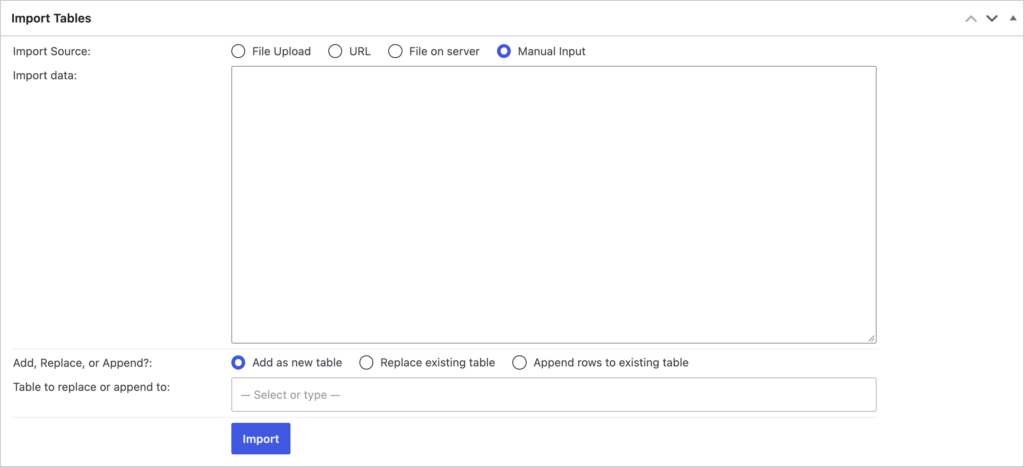
- Go to TablePress, then Import.
- Under Import Source, choose Manual Input and paste the code into the Import data box. The other sources are File Upload, for a saved HTML, CSV, JSON or Excel file, URL, and File on server.
- Leave Import Type as Add as new table. The other choices, Replace existing table and Append rows to existing table, are for updating a table you already have.
- Select Import. TablePress works out the format itself and opens the new table’s edit screen.
Name the table
On the edit screen, give the table a short Table Name that says what it contains, such as “Mileage rates 2026”. The name is what you search for in the list of tables, and it can be shown above the table so staff know what they are looking at. Add a Description if a sentence of explanation would help, for example the date the figures were last checked.
Edit and tidy the cells
The imported table appears as a grid of editable cells. Bold text, links and bullet points inside cells are kept as HTML, which is fine. Check for:
- Empty rows or columns that came with the copy. Tick the row or column and use the Table Manipulation buttons to delete it.
- Cells that were merged on the original page. TablePress imports them as separate cells, so check that the values are in the right places.
- Links to the old site that should now point at intranet pages.
Set the table options
These are further down the edit screen.
- Table Header: set “The first [1] rows are the table header” to 1, or more if the heading takes two rows. This is what makes the table accessible: screen readers read the column heading with each cell. Do not skip it.
- Table Footer: only for a totals row at the bottom.
- Print Table Name: tick it to show the name above the table. A visible title helps everyone, and on some intranets a TablePress extension also uses the name as the table’s caption for screen readers.
- Print Table Description: tick it to show the description above or below the table.
- Alternating Row Colors and Row Hover Highlighting: leave on. The Govintra theme styles TablePress tables to match the rest of the intranet, so you do not need to add CSS classes.
Table features for site visitors
The Enable Visitor Features tick box adds sorting by column, a search box, filtering and pagination to the table on the page. Turn it on for long reference tables, such as a list of extension numbers, where staff will want to find one row. Leave it off for short tables: the extra controls are clutter, and sorting does not work on tables with merged cells.
Select Save Changes. Then add the table to a page with the Table button on the editor toolbar: see Insert a table into a page. To build a table from scratch instead, see Create a new accessible table using TablePress.