
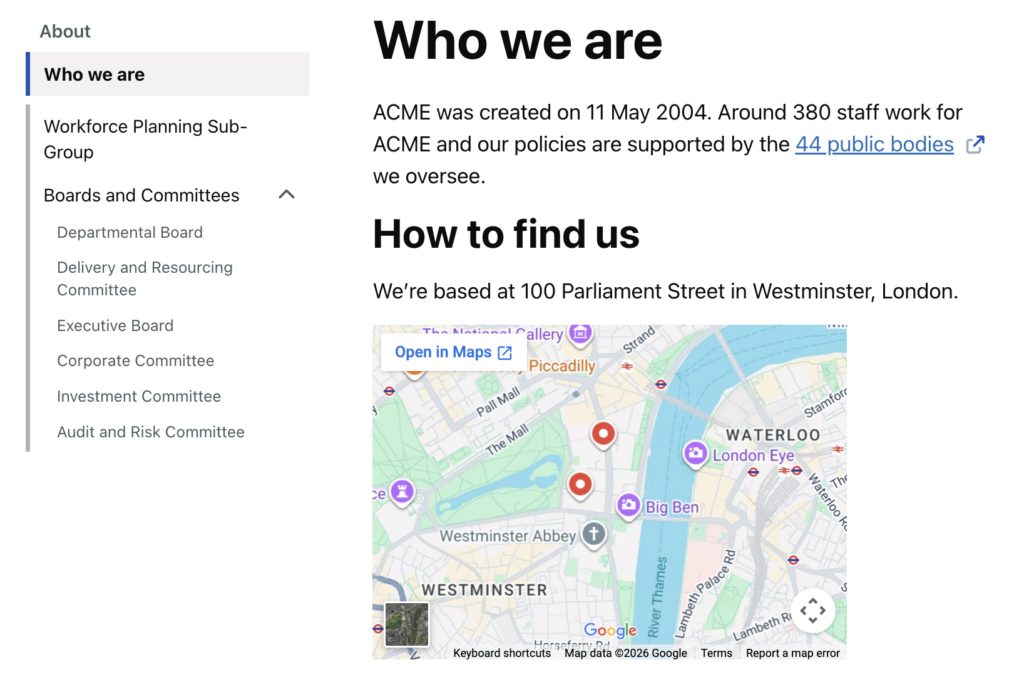
The Page with left navigation template gives a page three columns: a menu of related pages on the left, the page content in the middle, and a right-hand column for the page’s Sidebar box and widgets. The menu is built automatically from where the page sits in the page hierarchy, so it suits a section of the intranet made of parent and child pages, such as a board and governance set of pages or a set of annual account, where each page also needs its own.
Choose it in the Page Attributes box, under Template: see Change a page layout. It is available for pages only.
What the left navigation lists
The menu comes from the Parent setting in the Page Attributes box of each page. Nothing needs to be added on the Menus screen.
- The pages above: each ancestor of the current page, from the top of the section down, as links.
- The current page: shown in bold, not as a link.
- Its child pages: listed beneath it as links, in the order set by each child’s Order number.
- Grandchild pages: a child that has pages of its own gets a chevron. Selecting the chevron shows them; they start hidden.
- Sibling pages: once a page is two or more levels below the top of its section, its parent is shown with all of the parent’s children, so the reader can move sideways as well as up and down. A page directly under a top-level page shows only the pages above it and its own children.
Only published pages are listed; drafts and private pages never appear. To reorder the menu, change each page’s Order in Page Attributes or with Quick Edit in the Pages list. See Create pages for setting parents.
The right-hand column
The right column shows two things, in this order:
- Whatever you type in the Sidebar box under the editor. It is a full editor, so it can hold headings, links, images and shortcodes. It is written per page, so each page in a section can carry its own contacts or downloads.
When the Sidebar box is empty and the widget area has no widgets, the column is left blank. The content stays in the middle half of the page; it does not widen to fill the space. If you do not need a right column, use the wide version of the template.
Plain or wide: which to choose
- Page with left navigation: menu in the left quarter, content in the middle half, Sidebar box and right-hand widgets in the right quarter. Choose it when pages need something beside the text.
- Page with left navigation (wide): the same menu, content across the right three quarters, no right column. The Sidebar box is not displayed. Choose it for text-heavy pages, tables and forms.
Both show the breadcrumb trail, the title, the content and a list of any files added in the Document attachments box. Comments are not shown on this template, even when they are allowed on the page; the wide version does show them. On a phone the three columns stack: menu, then content, then the right-hand column.
Pages without a hierarchy
On a top-level page with no child pages the menu shows only the page’s own title, which looks empty. Use the Default template or the Full-width page template for pages that stand alone, and this template once a page has a parent or children. For navigation between unrelated pages, use a menu instead: see Setup navigation menus. All the other templates are described in Available templates.